














The Party Bar: Dubsado for Party Rentals, Plus an Airtable Balloon Calculator
If you’re looking at Dubsado for party rentals, this is what a full setup looks like when the business also needs to know exactly what’s on the shelf. The Party Bar offers balloons and specialty rentals as well as full-service event decor. I built a done-for-you Dubsado setup for both services, then built an Airtable base that tracks every rental piece by date and turns an event’s balloon designs and colors into an exact balloon order.
Dubsado for party rentals: results at a glance
- Service: Done-For-You Dubsado Setup with an Airtable build
- 2 services mapped into 12 Dubsado workflows with 38 emails
- 57 workflow steps, 46 of them automatic
- An estimated 275 hours a year back, worth about $6,870 in assistant time, from the project’s ROI report
- About 966 follow-ups, reminders and updates a year that now happen for every client instead of depending on someone remembering
- 226 rental variations tracked in Airtable, each with stock, price and restock time
- 18 balloon recipes across 7 balloon sizes
Service Provided
Done-For-You Dubsado Setup and a custom Airtable build for inventory and balloon ordering
About the Client
The Party Bar is an event business with two sides. One side rents out balloons, backdrops, flower walls, shimmer walls, arches and other specialty pieces. The other side designs and installs full-service event decor. Both sides pull from the same shelves, so a flower wall promised to one party cannot also go out to another party that weekend.
Balloons add their own math. A single garland or column can use dozens of balloons in several sizes and colors, and the owner has to order the right number of each before the event. Too few and the team is scrambling the night before. Too many and the extra cost comes out of the profit on the job.
The Problem
Before we started, the business ran its rentals on a dedicated rental software tool, took inquiries through a form on its website, and handled the client conversation, contracts and follow-up mostly by email. The rental software knew what was in stock, but it did not run the client side. Every inquiry meant someone writing back by hand, building a quote, chasing a signature and remembering to follow up after the event.
Balloon orders were worked out by hand for each event. Some designs had a known formula. Others, like balloon bows, had no set formula at all, so the owner made one up each time she sold one. That kind of knowledge lives in one person’s head, and it does not scale when the calendar fills up.
How We Mapped It
We spent a long process mapping session walking through both services from the first inquiry to the cleanup after the event. The biggest decision we made there was where each kind of work should live. Dubsado would run everything the client sees: the inquiry, the proposal, the contract, the payments and the follow-up. Airtable would run everything behind the scenes: what is on the shelf, what is booked on which date, and how many balloons to buy.
That decision let us strip a lot of internal chores out of the client workflows. Tasks like loading rentals into the van had been sitting in the client process, where they cluttered every project. We moved that kind of work to the inventory side and kept the client workflows focused on what the client needs to do next.
The Solution: Dubsado for the Client, Airtable for the Inventory
12 Dubsado workflows across two services
When someone fills out the inquiry form for balloons or specialty rentals, Dubsado starts a lead workflow that sends a consultation scheduler and follows up if they go quiet. Once the owner has a plan, a proposal workflow sends the proposal, follows up on it, and moves the project forward when it is signed and paid. About two weeks before the event, an add-on proposal goes out so clients can add extras while there is still time to prepare them.
Some jobs need more than one round of approval, so a separate proofing workflow handles designs the client has to sign off on. Smaller workflows cover wooden backdrops and balloons on their own, and two more send a polite reply when a request is not a good fit or the date is already taken. After the event, a post-event workflow asks for a review and sends an anniversary follow-up, with timing the owner can adjust by event type. Full-service event decor has its own lead, proposal and booked workflows.
Across both services, that adds up to 12 workflows, 38 emails and 57 steps. Forty-six of those steps happen on their own, and the 11 that stay manual are the ones that need a person, like customizing a proposal.
Rental inventory that knows the date
In Airtable, rentals are organized the same way the shelves are: categories, then items, then the specific variations of each item, like a ripple wall in white or a shimmer wall in gold. Each of the 226 variations has a gear tag, a stock quantity, a rental price and its dimensions. Kits bundle several pieces together, with the option to add up the pieces’ prices to set the kit price.
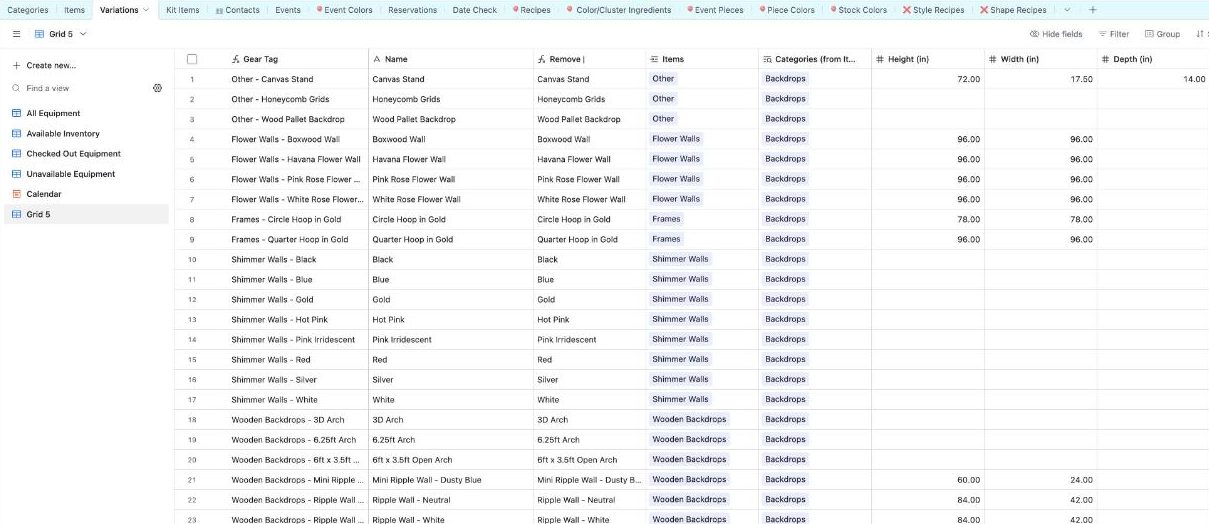
When the owner picks a date range, the base shows how many of each piece are free on those dates. Every reservation includes a restock buffer, so a piece that comes back late Saturday is not shown as available for an early Sunday setup. Reservations also track what has been checked out and checked back in, which makes it easy to see what is still out in the world after a busy weekend.
A balloon calculator
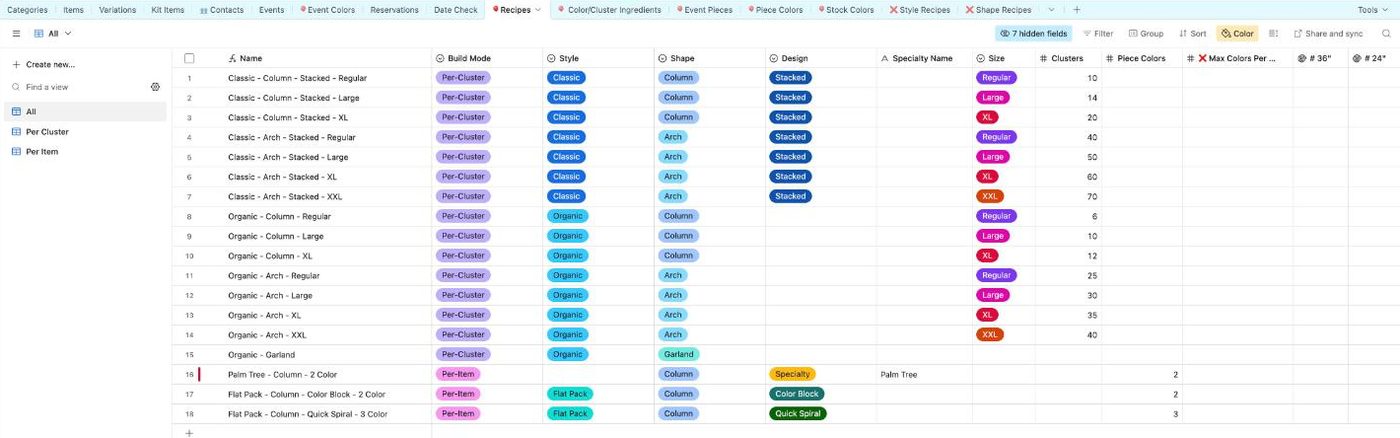
The balloon calculator took the most back-and-forth to get right. Balloon pieces come in two styles, classic and organic, and three main shapes: garlands, columns and arches. Classic pieces can also be stacked, and some designs use spirals or color blocks. My first version calculated everything by the cluster, which worked for most designs but broke on flat pack designs and specialty pieces like a palm tree column.
We reworked it so each recipe has a build mode. Cluster-based recipes list how many balloons of each size go into one cluster, and the base multiplies that by the feet of garland or the number of clusters. Per-item recipes, like a flat pack column in a color block or a quick spiral, simply list the balloons for the whole piece. There are 18 recipes across 7 balloon sizes, from 5 inch to 36 inch, plus toppers.
For an event, the team adds each balloon piece, picks the event’s colors in order, and sets one contingency percentage for the whole job instead of padding each piece separately. The base rolls everything up into a total for each balloon size in each color, and that total becomes the order. The goal was a shopping list for buying balloons, so the calculator stops there and leaves the assembly to the people who know how to build them.
The Results
- Every inquiry, proposal and booking runs through Dubsado workflows built for each service
- 46 of the 57 workflow steps run on their own, an estimated 275 hours a year the owner does not have to spend
- Availability for any date comes from the inventory, with restock time accounted for
- Checked-out and checked-in gear is tracked by reservation
- Balloon orders are calculated from the event’s pieces and colors instead of by hand
After our follow-up call, where I simplified the proposals and the design questionnaire, the owner told me she and a team member had gone through the system again and had a much easier time with it. She also had follow-up support with me to ask questions as real bookings came through.
Frequently asked questions
Why use Airtable alongside Dubsado for party rentals?
In The Party Bar’s setup, Dubsado runs the client experience from inquiry to post-event follow-up. Airtable handles the inventory and the balloon math, because those need stock counts by date and calculations across recipes, pieces and colors, which Dubsado is not designed to do.
Related case studies and reading
- Case study: SugarPop Productions: Dubsado for photo booths
- Case study: Live Wilder Studio: an Airtable dashboard fed by Dubsado
- Read: Dubsado and Airtable: Making Business Operations Smoother
- Read: Create a “Not a Good Fit” Sequence in Dubsado
Want a setup like this for your rental business?
I build done-for-you Dubsado setups for event businesses, and when Dubsado is not the right tool for a job, I build the rest in Airtable. See Done-For-You Airtable Setup or a Custom System Build.


In this power-packed session, I show you how to connect Airtable + your CRM for smarter tracking, simplified workflows, and insights that actually move your business forward.
From Guesswork to Growth with Airtable


A step-by-step guide to setting up your new Dubsado account, area by area, so your trial ends with a system you can actually use.
21 Ways to Max Out Your Dubsado Free Trial

Hot Seat, Hot Takes, Hot Damn.

Free masterclasses that show you exactly how scalable businesses are built.




© 0000 Cait Potter Creative, LLC
Privacy Statement and Terms & Conditions


